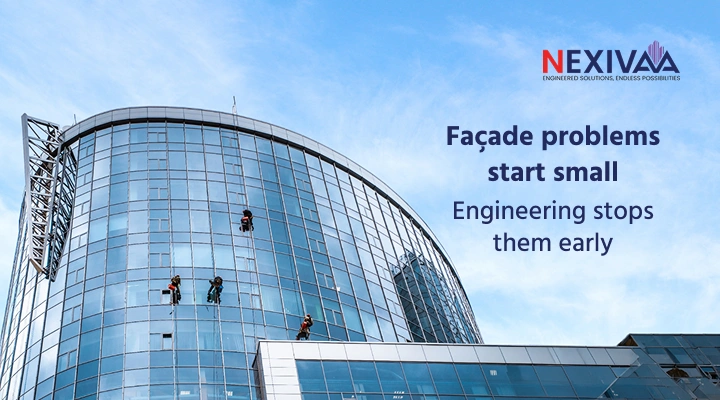
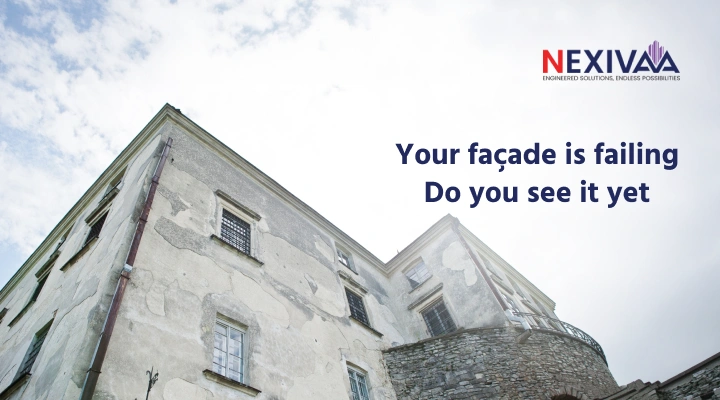
Commercial buildings across India are showing signs of façade distress every day. Curtain wall failure and cladding failure are not sudden events. They develop slowly, through years of thermal cycling, UV exposure, moisture infiltration, and material fatigue. By the time the damage is visible to the naked eye, the underlying problem has often been active for seasons.
Recognizing the early warning signs of curtain wall failure is the difference between a targeted repair and a full-scale remediation project.
This guide walks through the seven most critical warning signs that your curtain wall or cladding system needs immediate attention, and what each one means for your building.
What causes cladding and curtain wall failure
Curtain wall and cladding systems are built to last decades, but they are not maintenance-free. Sealants and gaskets degrade after 10 to 15 years. Glazing units begin failing after 20 to 25 years. Metal fixings corrode wherever moisture reaches them.
Failure is almost always a process, not an event. A small sealant gap or a loose fixing left uninspected compounds over time until the damage becomes visible and expensive.
The most common causes include:
- Sealant and gasket degradation from age, UV exposure, and thermal movement/li>
- Water infiltration through failed joints or blocked drainage channels
- Anchor and fix corrosion-causing panels to prevent them from loosening or shifting
- Delamination of composite cladding materials, including ACM panels
- Differential structural movement opening joints between the curtain wall and the building structure
- Poor original installation or specification decisions
Understanding these failure mechanisms is the foundation of effective curtain wall maintenance and building façade inspection.
7 Warning signs of cladding system or curtain wall failure
1. Water staining or streaking around glazing frames
Brown or white streaks running vertically from glazing frames or panel joints are one of the earliest and most reliable indicators of curtain wall failure. These stains form when water infiltrates through a failed sealant or blocked drainage channel and carries dissolved minerals or pollutants onto the façade surface.
Water staining that appears after rain or has visibly widened since the last observation should be documented and reported immediately for professional assessment. The stain on the surface is rarely at the entry point; water typically travels behind the system before exiting, meaning the real source may be several floors above the visible damage.
2. Drafts or air infiltration near windows and panel edges
Perceptible cold air movement near glazing perimeters or panel edges from inside the building indicates that the sealing system has been compromised. Gasket failure and sealant shrinkage are the most common causes, creating air pathways through what should be a continuous, sealed envelope.
Beyond occupant discomfort, air infiltration is a direct indicator of the risk of water infiltration. Any gap large enough to let air through will also let wind-driven rain in during storms. This is a curtain wall maintenance issue that should not be deferred.
3. Cracked, shrunk, or missing sealant at panel joints
Sealant joints are inspectable from nearby vantage points or with binoculars. Visible cracking, shrinkage, pulling away from the substrate, or missing sealant sections are clear signs of cladding failure that the first line of weather defense has been lost.
Sealant failure is the single most common cause of curtain wall water infiltration. When observed, the appropriate response is a professional close-up inspection to assess the full extent, followed by systematic sealant replacement using a product correctly specified for the façade system type and movement characteristics.
4. Condensation or fogging between glass panes
Fogging or condensation visible between the two panes of a sealed glazing unit indicates that the hermetic seal of the insulating glass unit has failed. Once the seal fails, moist air enters the cavity, the insulating gas is lost, and thermal performance drops significantly. The unit cannot be resealed in place; it must be replaced.
This sign does not pose an immediate structural risk but is an important indicator of glazing system age and cumulative thermal stress. Buildings showing multiple fogged units across an elevation should have a full glazing condition survey completed as part of their cladding inspection services program.
5. Loose, rattling, or bowing cladding panels
Panel movement- visible bowing outward or inward, misalignment with adjacent panels, or audible rattling in the wind- is one of the most urgent warning signs on this list. Loose or bowing cladding panels can detach under wind loading and fall, posing a direct safety risk to occupants and pedestrians below.
Causes include corroded or failed fixings, anchor pull-out from the substrate, and delamination of composite panel materials. This is not a sign to monitor or defer. Any detected panel movement should trigger an immediate assessment of the commercial façade.
6. Rust stains at anchor or fixing points
Rust-colored streaking running downward from visible fixing points indicates that moisture has reached the steel anchors or brackets that hold the cladding to the structure. Steel anchor corrosion is a structural concern because corroded fixings progressively lose their load-bearing capacity, reducing the restraint that keeps panels secured to the building.
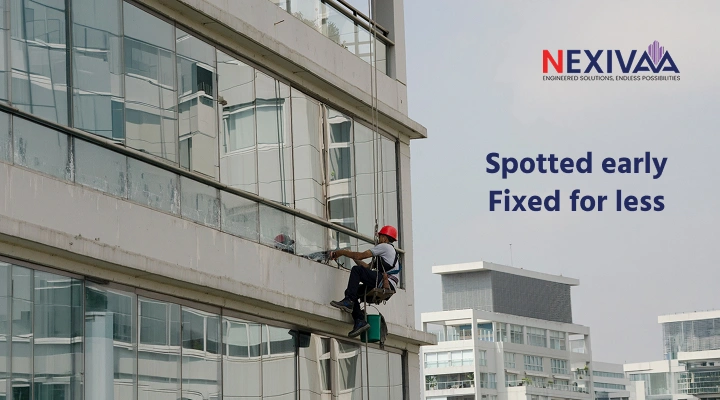
Routine façade inspection of the building using rope access or elevated platforms is the only reliable way to detect anchor corrosion before it becomes a structural concern.
7. Cracks or delamination in cladding panels
Visible cracking in cladding panels indicates that the material has been pushed beyond its thermal or structural limits. For composite panels, delamination occurs when internal layers begin to separate. This can be identified by tapping the surface; a hollow sound confirms the separation.
Both conditions are serious. Delaminated panels pose a falling risk and require immediate specialist assessment. Even hairline cracks in masonry or EIFS cladding open direct pathways for water, which India’s monsoon conditions will exploit rapidly.
DIY visual checks vs. when to call a specialist
Some initial checks can be performed by a building manager or facility team:
- Observe the exterior façade after rainfall for new staining or streaking
- Note any drafts near glazing perimeters from inside occupied floors
- Photograph visible cracks, bowing, or misaligned panels from ground level
- Tap accessible cladding panels to check for hollow delamination sounds
However, the following require a qualified façade engineer with appropriate access equipment:
- Close-up sealant and gasket condition assessment across all elevations
- Anchor and structural fixing condition survey
- Water penetration testing to confirm and locate infiltration pathways
- Thermal imaging to detect hidden moisture within the wall assembly
- Full cladding inspection services report with defect classification and prioritization
Curtain wall repair vs. full replacement: How to decide
Never make this decision based on a visual check alone. A professional condition survey is the only reliable way to determine the right scope.
Repair is the right call when:
- Failures are localized to specific zones
- The structural framing is sound
- Anchors retain adequate capacity
Full replacement is indicated when:
- The system is over 30 years old
- Failures are widespread across multiple elevations
- Water infiltration has compromised the structural frame
The earlier cladding failure signs are caught, the more options you have, and the lower the cost. Regular curtain wall maintenance and building façade inspection are always cheaper than emergency remediation.
Why Nexivaa is the right partner for curtain wall and cladding assessment in India
When signs of curtain wall failure appear on your building, the quality of the assessment determines the outcome. At Nexivaa, our façade and fenestration consulting team brings engineering rigor to every inspection, forensic audit, and commercial façade repair recommendation we deliver.
Here is why building owners and developers across India trust Nexivaa:
- Specialist façade forensic audits: Our forensic audit service is specifically designed to investigate curtain wall system failures, cladding system issues, water infiltration, thermal performance failures, and structural glazing concerns, not generic building surveys.
- End-to-end field services: From initial building façade inspection to detailed condition reporting, defect classification, and remediation planning, Nexivaa covers the complete assessment lifecycle.
- Cladding system expertise across materials: Whether your building uses unitized curtain wall, stick-built glazing, ACP cladding, or structural glazing, our engineers understand the failure mechanisms specific to each system.
- India-specific engineering knowledge: Our assessments are grounded in India’s climate, construction practices, and building stock, rather than imported frameworks that do not reflect local realities.
- Actionable reporting: Every Nexivaa assessment delivers a prioritized defect schedule with clear recommendations, not a generic condition report that leaves you uncertain about next steps.
Your building’s façade is its first line of defense. If it is showing signs of curtain wall failure, the time to act is before the next monsoon season compounds the damage.
Reach out to us for a façade assessment today.
FAQs
1. What are the warning signs of curtain wall failure?
The key warning signs include water staining or streaking around glazing frames, drafts near window perimeters, cracked or missing sealant at panel joints, condensation between glass panes, loose or rattling cladding panels, rust stains at anchor points, and visible cracks or delamination in cladding panels. If two or more of these signs are present, a professional building façade inspection should be arranged without delay.
2. What causes a curtain wall to leak?
Sealant degradation is the most common cause, followed by failed gaskets at glazing perimeters, blocked internal drainage channels, and differential movement between the curtain wall and the primary building structure. In India’s climate, accelerated UV degradation and thermal cycling during extreme summer temperatures significantly shorten sealant service life compared to temperate-climate benchmarks.
3. How often should curtain walls be inspected?
A close-up professional inspection should be conducted every three to five years, supplemented by an annual visual check from ground level or accessible vantage points. Buildings older than 15 years, those in high-humidity coastal environments, or those with a known repair history warrant more frequent assessment. Given India’s monsoon cycle, a pre-monsoon inspection every year is a sensible baseline for any commercial building.
4. Can curtain wall failure cause structural damage?
Yes. Prolonged water infiltration through failed curtain wall or cladding joints can corrode structural steel, degrade concrete, and cause progressive damage across multiple floors. What begins as a façade maintenance issue can escalate into a structural remediation project if left unaddressed. Early detection through cladding inspection services is the most effective way to prevent this escalation.
5. Can curtain wall be repaired without full replacement?
In most cases, yes. If the aluminum framing and structural connections are sound, targeted repairs including sealant reapplication, gasket replacement, individual panel swaps, and drainage clearing can restore full performance. A professional condition survey is essential to determine whether repair or replacement is the correct and most cost-effective approach for the specific building and failure pattern.