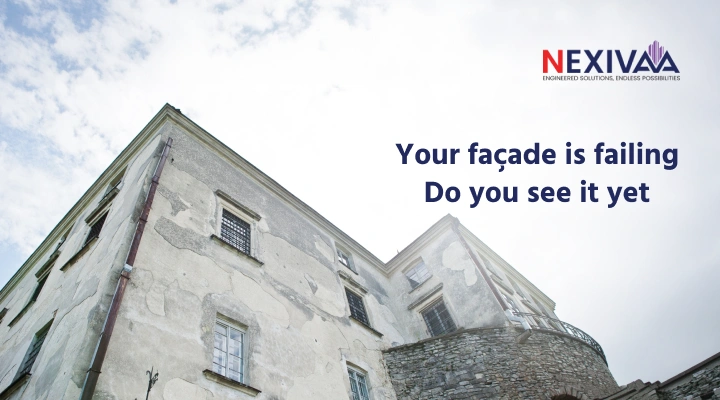
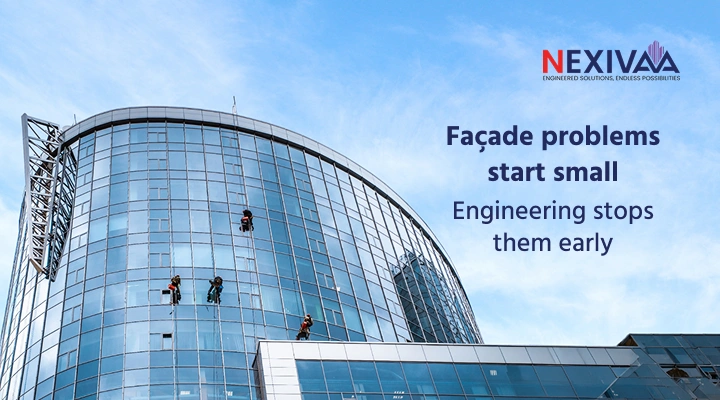
Every building tells a story through its façade. Cracks in the cladding, water stains running below window frames, panels that rattle in the wind; these are not cosmetic inconveniences. They are symptoms of building façade issues that have been developing quietly, often for seasons, before they become visible. Understanding common façade problems is the first step toward protecting the structural integrity, performance, and longevity of any commercial or industrial building façade.
This guide covers the most common façade failures, their causes, and what every building owner and property manager needs to know before damage compounds.
Why façade problems are more serious than they look
A building’s façade is its primary barrier against weather, heat, moisture, and structural stress. When that barrier is compromised, the consequences extend far beyond the surface. Water entering through a failed joint does not remain at the point of entry. It tracks behind cladding, reaches structural steel and concrete, and causes corrosion and degradation that can spread across multiple floors before a single stain appears on an interior wall.
Common façade problems share one characteristic: they are almost always more advanced than they appear when they are noticed. What appears to be surface staining is often evidence of infiltration that has been active for two or three monsoon seasons. What looks like a loose panel is often a fixing system that has been corroding for years.
This is why routine engagement with a qualified façade inspection company is not optional for owners of commercial and industrial building façades. It is the only reliable way to catch failures at the stage when they are still manageable.
The most common façade problems on commercial and industrial buildings
1. Sealant failure
Sealant failure is the most widespread building façade issue. Every joint between panels, glazing units, and frames depends on sealant to remain weatherproof. Sealants have a realistic service life of 10 to 15 years in standard conditions. In India’s climate, that window is shorter. Intense UV radiation, extreme thermal cycling between summer peaks and cooler months, and sustained monsoon moisture all accelerate degradation.
Signs of sealant failure include:
- Visible cracking, shrinkage, or pulling away from the substrate at joints
- Discoloration or darkening along sealant lines
- Water staining below joint locations after rainfall
Once the sealant fails, every joint it protected becomes a potential water entry point. Addressing sealant failure promptly is one of the most cost-effective façade maintenance decisions a building owner can make.
2. Water infiltration
Water infiltration is the consequence that follows most other façade failures. It enters through failed sealant joints, blocked internal drainage channels, poorly detailed junctions at parapets and window heads, and gaps created by differential structural movement.
The deceptive nature of water infiltration is that the entry point and the visible damage are rarely in the same location. Water entering through a joint on the eighth floor can track behind cladding and appear as a damp patch on the sixth-floor interior wall. By the time it is visible, it has typically been active across multiple monsoon seasons.
Left unaddressed, water infiltration causes:
- Corrosion of structural steel and fixing systems behind the cladding
- Degradation of insulation materials within the wall assembly
- Mould growth within wall cavities
- Progressive damage to internal finishes across multiple floors
3. Thermal bridging
Thermal bridging is one of the least visible yet most performance-damaging common façade problems. It occurs when a material with high thermal conductivity, typically a metal frame or fixing, creates a direct pathway through the building envelope, bypassing the insulation layer.
In aluminum curtain wall and cladding systems, the metal frame is the bridge. On a peak summer afternoon in Delhi, the exterior surface of an aluminum frame can exceed 70 degrees Celsius. Without a thermal break, that heat conducts directly into the cooler interior, regardless of how much insulation sits in the panels on either side.
For commercial building owners, thermal bridging translates directly into higher cooling loads, higher electricity bills, and occupant discomfort near the building perimeter.
4. Panel delamination
Panel delamination is specific to composite cladding systems, most commonly aluminum composite panels. Delamination occurs when the bond between the panel’s outer aluminum skins and the core material begins to break down. This can result from thermal stress, moisture ingress behind the panel, or issues with the original material.
Delamination can be identified by tapping the panel surface. A hollow sound where there should be a solid one confirms internal separation. Delaminated panels are a safety concern because separated sections can detach under wind loading, particularly on upper floors of high-rise buildings.
5. Fixing and anchor corrosion
Every cladding panel and curtain wall component is held to the building structure through a system of fixings, brackets, and anchors. These are typically steel, and wherever moisture can reach them, corrosion begins.
Fixing corrosion is insidious because it is almost entirely hidden from view. The first external sign is rust streaking running downward from fixing locations on the façade surface. By the time this becomes visible, the fixing itself may already have lost a significant portion of its load-bearing capacity.
On industrial building façades and high-rise commercial developments, corroded fixings represent a structural safety risk that requires immediate professional assessment.
6. Glazing unit failure
Sealed insulating glazing units have a finite service life. After 20 to 25 years, the hermetic seal that keeps the cavity between the glass panes airtight begins to fail. Once the seal goes, moisture enters the cavity, and the unit fogs internally. Fogged units cannot be resealed in place; they must be replaced.
Beyond aesthetics, failed glazing units lose their thermal insulation, increasing heat gain and the risk of condensation.
7. Structural movement and joint failure
Buildings move. Thermal expansion and contraction, foundation settlement, wind loading, and seismic activity all cause movement that the façade system must accommodate. When movement joints are inadequately designed, incorrectly sized, or blocked during installation, the façade has nowhere to transfer that stress.
The result is cracking at panel edges, sealant tearing at corners, and in severe cases, panel distortion or displacement. This is particularly common on industrial building façades where large panel spans and significant thermal exposure create substantial movement demands.
DIY checks vs. professional façade inspection
Some early warning signs can be identified through regular observation:
- Water staining or streaking on the exterior surface after rainfall
- Visible cracks or gaps in sealant at panel joints
- Rattling or movement in cladding panels during wind
- Fogging between glazing panes
- Rust streaking below fixing locations
However, identifying the root cause, assessing the structural implications, and determining the correct remediation approach requires professional expertise and close-up access. A qualified façade inspection company will conduct systematic elevation surveys, water penetration testing, fixing condition assessments, and thermal imaging to give building owners a complete and accurate picture of their façade’s health.
How Nexivaa helps building owners across India address common façade problems
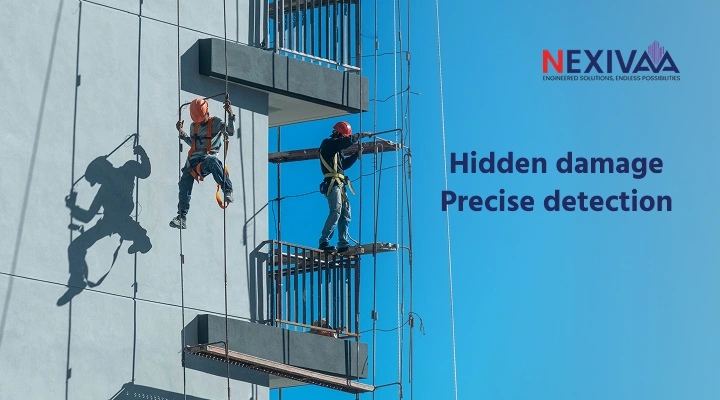
When common façade problems go undetected or unaddressed, the cost of remediation grows with every season. At Nexivaa, our façade field services and forensic audit capabilities are specifically designed to identify, diagnose, and prioritize building façade issues before they escalate into structural emergencies.
Here is what sets us apart as a façade inspection company and consulting partner:
- Specialist forensic audits that investigate curtain wall failures, cladding system issues, water infiltration pathways, thermal performance failures, and fixing conditions across commercial and industrial building façades
- Systematic façade surveys covering every elevation, every joint, and every fixing zone with engineering-level documentation
- Thermal performance assessments identifying bridging, insulation gaps, and glazing failures that are invisible to a standard visual inspection
- Clear, prioritized remediation reporting that tells building owners exactly what needs attention now, what can be scheduled, and what the consequences of delay are
- End-to-end façade consulting from pre-tender design validation through to post-installation quality assurance
We serve commercial developers, property managers, and building owners across Delhi NCR, Greater Noida, and project locations spanning India’s major urban centers.
If your building is showing any of the common façade problems outlined in this guide, the right time to act is before the next monsoon season compounds the damage.
Talk to us and get your façade assessed today.
FAQs
1. What are the most common façade problems in Indian commercial buildings?
The most common building façade issues in India include sealant failure, water infiltration, thermal bridging, panel delamination, corrosion of fixings and anchors, glazing unit seal failure, and structural movement joint failure. India’s climate conditions, particularly intense UV exposure, extreme thermal cycling, and sustained monsoon moisture, accelerate the rate at which these failures develop compared to buildings in more temperate climates. Regular inspection by a qualified façade inspection company is the most effective way to catch these issues before they compound.
2. How do I know if my building’s façade has a water infiltration problem?
The most visible signs are water staining or streaking on the exterior surface below joint locations, damp patches or tide marks on internal walls near the building perimeter, and bubbling or peeling of internal finishes. However, the visible signs almost always understate the true extent of the problem because water tracks behind cladding before it becomes visible. A professional façade survey with water penetration testing is the only reliable way to identify and locate all active infiltration pathways.
3. Are façade problems more severe in industrial buildings than commercial ones?
Industrial building façades face some specific challenges that amplify common failure modes. Larger panel spans create greater thermal movement demands. Industrial environments often involve higher levels of vibration, pollution, and chemical exposure that accelerate material degradation. The inspection and maintenance requirements for industrial building façades are therefore at least as demanding as for commercial buildings, and in many cases more so.
4. How often should a commercial building’s façade be professionally inspected?
A close-up professional inspection by a qualified façade inspection company should be conducted every three to five years as a baseline. Buildings older than 15 years, those with a known repair history, or those in high-exposure environments such as coastal or heavily polluted urban locations should be inspected more frequently. In India specifically, an annual pre-monsoon visual check is a sensible minimum for any commercial building, given the intensity of the monsoon season’s impact on façade components.
5. Can façade problems be repaired without full replacement of the system?
In most cases, yes. Targeted repair is viable when the structural frame and fixing system remain sound and failures are localized. Sealant re-application, gasket replacement, individual panel swaps, and drainage clearing can restore full performance at a fraction of the full replacement cost. The key is an accurate diagnosis. Attempting repair without understanding the root cause risks addressing symptoms while the underlying failure continues. A thorough façade forensic audit establishes the correct scope before any remediation work begins.