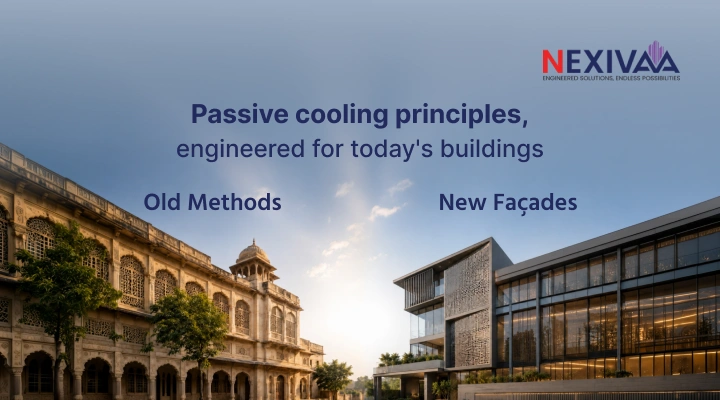
Long before mechanical air conditioning existed, India’s builders had already cracked the code on keeping structures cool. From the wind-catching towers of Rajasthan to the jaali-screened havelis of Gujarat, passive cooling was not a design feature. It was a survival strategy. The results were buildings that stayed comfortable through 45-degree summers without consuming a single unit of electricity.
Today, as India’s cities rapidly expand with commercial building façades of glass and aluminum, energy bills are climbing, and comfort levels are falling. The irony is striking. Modern architectural façades, for all their engineering sophistication, are often outperformed thermally by structures built hundreds of years ago with mud, stone, and empirical wisdom.
This is where modern façade systems, informed by climate-responsive architecture, step in. Not to replace traditional wisdom, but to engineer it. The principles have not changed. The materials and methods have.
To understand how India’s ancient architecture approached passive cooling in practice, watch the video below.
View this post on Instagram
What India’s ancient architecture actually understood about heat
The builders of pre-modern India were not working with thermal simulation software or U-value calculators. But they were observing, iterating, and refining solutions over centuries. What they arrived at was a deeply place-specific, climate-responsive architecture that addressed the same problems sustainable building design is trying to solve today.
These are the core passive cooling principles they mastered:
- Shading before insulation:
Direct solar radiation was blocked at the building’s outer skin before it could convert to heat inside. Deep overhangs, perforated screens, and recessed openings intercepted the sun’s rays rather than absorbing them. - Thermal mass as a buffer:
Thick walls of stone, brick, or packed earth absorbed heat slowly during the day and released it gradually at night. The building interior was always hours behind the outdoor temperature. - Stack ventilation for passive cooling:
Courtyards, wind towers, and vertical shafts created pressure differentials that drew cool air in at low levels and expelled warm air at the top without any mechanical assistance. - Orientation as a first principle:
Buildings were positioned to minimize exposure to the harsh west and south-west afternoon sun. Streets in traditional Indian towns were often aligned east-west for this very reason. - Evaporative and surface cooling:
Lime plaster, water features within courtyards, and vegetation cooled surfaces through evaporation, reducing the radiant heat that occupants experienced.
Each of these principles addressed a specific heat transfer pathway. Together, they created buildings that were thermally intelligent in ways many contemporary structures are not.
Where modern façade systems pick up the thread
Façade engineering today is not starting from scratch. It is, in many respects, formalizing and scaling what vernacular Indian architecture intuited. The difference is precision. Modern façade systems can now calculate, simulate, and validate the same outcomes that traditional builders achieved through observation and experience.
Here is how each traditional principle maps directly to a modern façade engineering solution.
The jaali and the chajja: Now solar heat gain analysis and external shading design
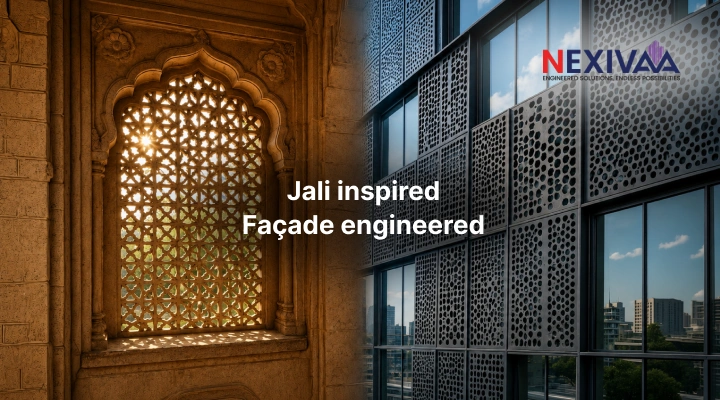
The jaali was India’s original solar filter, a perforated stone or brick screen that blocked direct sunlight while allowing diffuse light and moving air to pass through. The chajja, a deep overhanging slab above every opening, performed the same function vertically.
In contemporary façade engineering, this translates directly into solar heat-gain analysis and the design of shading systems. Before a single panel is specified, a façade engineer evaluates:
- The Solar Heat Gain Coefficient (SHGC) of proposed glazing systems for each orientation
- The geometry and dimensions of external shading fins, louvers, and overhangs required to intercept peak solar angles
- The balance between shading effectiveness and useful daylight penetration
- The interaction between shading devices and the building’s energy performance across all seasons
A west-facing commercial building façade in Delhi without engineered shading is the modern equivalent of a window with no chajja. The principle is identical. The engineering makes it precise.
How thick walls deliver thermal performance and better U-values
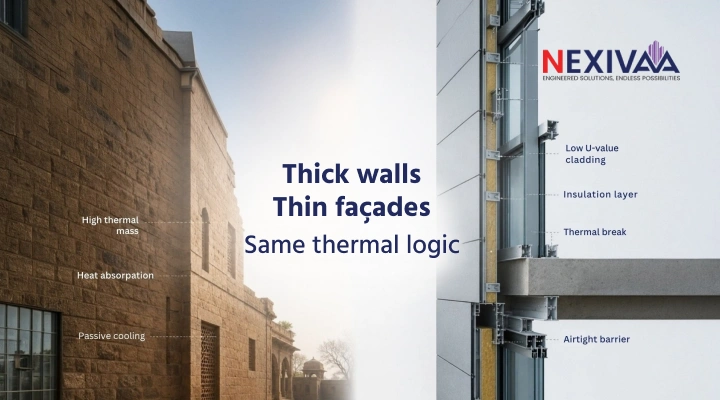
A 600-mm-thick stone wall in a Rajasthani haveli had thermal mass that kept the interiors cool until late afternoon, regardless of outdoor temperatures. Modern construction cannot replicate this geometry. But façade engineering can replicate the thermal performance.
Through detailed thermal analysis, a façade consultant specifies cladding assemblies that deliver comparable thermal resistance:
- U-value calculations determine the rate of heat transfer through the entire wall assembly, from exterior cladding to interior finish
- Thermal bridging assessments identify metal frames, fixings, and junctions where heat bypasses insulation and flows directly into the building
- Material selection optimizes the combination of insulation type, thickness, and cladding finish to achieve the target thermal performance
- Condensation risk analysis ensures the thermal assembly performs without moisture problems across India’s range of seasonal conditions
The result is a modern thin-skin façade that performs like a thick wall. Different materials, same physics.
The courtyard: Now ventilated façade cavity systems and thermal comfort modeling
The Indian courtyard was a natural HVAC system. Hot air rising from the courtyard floor created an upward draft that drew fresh air in from shaded lower openings. The courtyard also acted as a thermal buffer, shielding surrounding rooms from direct solar exposure.
In eco-friendly building design today, this stack ventilation principle is engineered into ventilated façade systems and validated through thermal comfort modeling:
- Ventilated cavity façade systems create an air gap between the cladding and the building wall, allowing heat to escape upward rather than conduct inward
- Thermal comfort modeling simulates how heat moves through and around the building envelope under Indian summer conditions, identifying hot zones before they are built
- Passive ventilation strategy integrates with façade design to reduce reliance on mechanical cooling systems
Orientation: Pre-tender design validation for climate-responsive architecture
Traditional Indian town planning instinctively understood orientation. Modern commercial development often does not. A building whose long axis faces west commits its occupants to decades of afternoon heat gain, regardless of how advanced the glazing system is.
Façade engineering addresses this at the pre-tender stage, before any material is procured or any structure is built:
- Orientation analysis maps the building’s façade exposure against India’s sun path data for its specific latitude
- Wall-to-window ratio optimization by elevation reduces glazing on high-gain orientations and allows more on lower-gain faces
- Integrated assessment of orientation, shading, and glazing specification treats these as a combined system rather than isolated decisions
This is exactly the judgement that traditional Indian builders made instinctively. Façade engineering makes it calculable, documentable, and verifiable.
Why modern façade systems must be climate responsive, not climate agnostic
India has five distinct climate zones: hot-dry, warm-humid, composite, temperate, and cold. A façade system designed for London’s grey skies will perform catastrophically on a south-facing commercial building in Ahmedabad. Yet imported design aesthetics and specification habits continue to produce exactly this mismatch across Indian cities.
Climate-responsive architecture in the façade context means:
- Specifying glazing with SHGC values appropriate for the building’s climate zone and orientation, not generic international defaults
- Designing shading that responds to the actual sun path at the project’s latitude
- Selecting cladding systems with thermal performance suited to the local temperature differential between indoor comfort conditions and outdoor peak temperatures
- Validating the complete façade assembly against India’s Energy Conservation Building Code requirements for the relevant climate zone
Sustainable building design for India is not about applying global green building templates. It is about understanding what India’s climate demands and engineering a building envelope that responds to it. This is precisely what India’s ancient builders did without simulation software. They observed their climate, understood its patterns, and designed accordingly.
Modern façade engineering has the tools to do this with far greater precision. The question is whether those tools are being used.
The cost of ignoring passive cooling principles in modern architectural façades
When passive cooling principles are ignored in commercial building façade design, the consequences are measurable and recurring:
- Cooling loads increase significantly, directly inflating electricity bills for the building’s entire operational life
- Occupant comfort near glazed perimeters falls, affecting productivity in office environments and satisfaction in residential and hospitality projects
- Thermal stress on façade components accelerates degradation, particularly in sealant joints, gaskets, and cladding fixings exposed to repeated heat cycling
- Green building certification targets become harder to meet, affecting the building’s marketability and compliance position
- Retrofit interventions to correct thermal performance failures are significantly more expensive than getting the specification right at the design stage
None of these outcomes is inevitable. They are the result of façade decisions made without engineering analysis. India’s traditional builders could not afford to get it wrong because there was no retrofit option. Modern buildings have a second chance through façade consulting. But using it after the fact costs far more than using it at the start.
How Nexivaa brings this thinking to every project
At Nexivaa, we believe that the most advanced façade solution for India is one that understands both where the country has come from and where its buildings need to perform. Our approach to façade and fenestration consulting is grounded in the same principles that India’s traditional builders applied instinctively, now delivered with engineering rigor and climate-specific analysis.
Our sustainability consulting services directly implement the passive cooling principles outlined in this blog:
- Solar heat gain analysis:
We evaluate radiation effects on your façade and design shading strategies that intercept peak heat gain before it enters the building, engineering the function that a chajja performed for centuries. - Thermal bridging assessment:
We identify every pathway through which heat bypasses your insulation and specify solutions that deliver the thermal continuity a thick stone wall provided naturally. - U-value calculations:
We determine the precise thermal transmittance of your complete façade assembly and optimize it for your building’s climate zone and orientation. - Thermal comfort modeling:
We simulate how heat moves through your building envelope under Indian summer conditions, replicating the comfort analysis that traditional courtyard design achieved through spatial intelligence. - Pre-tender design validation:
We assess orientation, wall-to-window ratios, and façade system selection before any materials are procured, identifying decisions that cannot be corrected once construction begins.
India knew how to beat the heat 500 years ago. We know how to engineer it today.
If your next project is in the design stage, or if an existing building is underperforming thermally, the conversation starts with a façade assessment. Talk to our team before next summer makes the decision for you.
Schedule your façade consultation with us!
FAQs
1. What is passive cooling in the context of modern façade systems?
Passive cooling refers to reducing a building’s internal heat gain through design and material choices rather than mechanical systems. In modern façade engineering, this means specifying glazing with low solar heat-gain coefficients, designing external shading devices, selecting cladding with appropriate thermal mass or insulation, and validating the building’s orientation. The goal is a façade that limits heat entry, reducing or, in some cases, eliminating cooling loads on mechanical systems for parts of the year.
2. How does solar heat gain analysis differ from standard glazing specification?
Standard glazing specification typically selects a product based on cost, aesthetics, and general performance categories. Solar heat gain analysis goes further; it calculates the actual quantity of solar radiation that will enter the building through the proposed glazing at each orientation, at each critical hour and season, for the building’s specific latitude. It then evaluates whether the proposed glazing, combined with any shading devices, will keep heat gain within acceptable limits for the building’s occupancy type and climate zone.
3. Can passive cooling principles be applied to an existing building, or only to new construction?
Both scenarios are addressable, though the available interventions differ. For new construction, the full range of passive cooling tools is available from the design stage. For existing buildings, options include retrofitting external shading devices, applying solar-control window film, improving insulation in accessible wall assemblies, and addressing thermal bridging at exposed framing elements. A façade audit of the existing building identifies which interventions are technically feasible and most cost-effective for the specific structure.
4. What is the relationship between ECBC compliance and passive cooling?
India’s Energy Conservation Building Code prescribes minimum performance requirements for building envelopes, including maximum U-values for walls and roofs, maximum SHGC values for glazing by orientation, and maximum wall-to-window ratios by climate zone. Passive cooling principles, when properly engineered into a façade, typically produce a building envelope that meets or exceeds these requirements. ECBC compliance is therefore both a regulatory obligation and a practical benchmark for the thermal performance that passive cooling engineering should deliver.
5. How does thermal bridging affect a building’s cooling performance in Indian summers?
Thermal bridging occurs when a material with higher thermal conductivity creates a pathway through the building envelope that bypasses the insulation layer. In aluminum curtain wall and cladding systems, the metal frame is typically the bridge — conducting heat from the hot exterior surface directly to the cooler interior. In Indian summers, when exterior surface temperatures on a south- or west-facing metal frame can exceed 70°C on peak days, thermal bridging is a significant contributor to the internal heat load.