Façade design plays a critical role in how a building performs, ages, and is maintained over time. While façades are often treated as visual elements, they are complex systems that protect structures from weather, regulate energy performance, and influence long-term maintenance costs. Many recurring building problems can be traced to façade design errors during the early planning stages.
By understanding common façade design problems and addressing them early, developers, architects, and contractors can avoid long-term issues and deliver buildings that perform reliably throughout their lifecycles.
Mistake 1 – Ignoring climate and environmental conditions
One of the most common façade design issues occurs when systems are selected without considering local climate conditions. Wind pressure, rainfall intensity, humidity, temperature variation, and pollution levels directly affect how a façade behaves over time. When these factors are overlooked, façades are more likely to experience water leakage, surface damage, thermal discomfort, and frequent maintenance requirements.
A professional façade design company evaluates site-specific environmental conditions early and recommends systems that are suitable for real-world exposure.
Mistake 2 – Focusing on appearance over performance
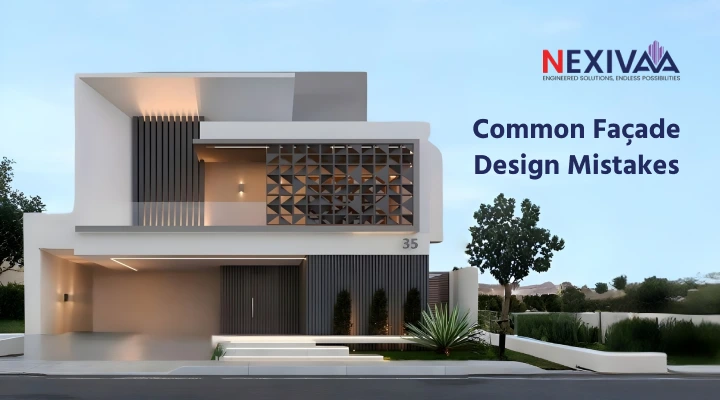
While aesthetics are important, prioritizing appearance alone often leads to long-term façade design problems. Materials chosen purely for visual appeal may not perform well under thermal movement, structural loads, or prolonged exposure to weather. This can result in cracking, sealant failure, reduced insulation performance, and higher energy consumption.
Successful façade solutions balance architectural intent with engineering performance to ensure durability and efficiency.
Mistake 3 – Inadequate façade detailing
Many façade design issues arise from weak or incomplete detailing rather than material failure. Poorly defined junctions, unclear fixing methods, and missing movement allowances create confusion during construction. When drawings lack clarity, site teams are forced to interpret details, increasing the risk of execution errors.
Clear, buildable detailing is essential to ensure that the façade system performs as intended.
Mistake 4 – Poor coordination between design teams
Façade systems sit between architecture, structure, and building services. When coordination between these disciplines is weak, conflicts often arise on-site. Structural elements may clash with façade fixings, services may interfere with drainage paths, and openings may not align correctly.
Early collaboration between the façade design company, façade contractor, and other consultants helps prevent redesigns, delays, and unnecessary costs.
Mistake 5 – Ignoring maintenance and access planning
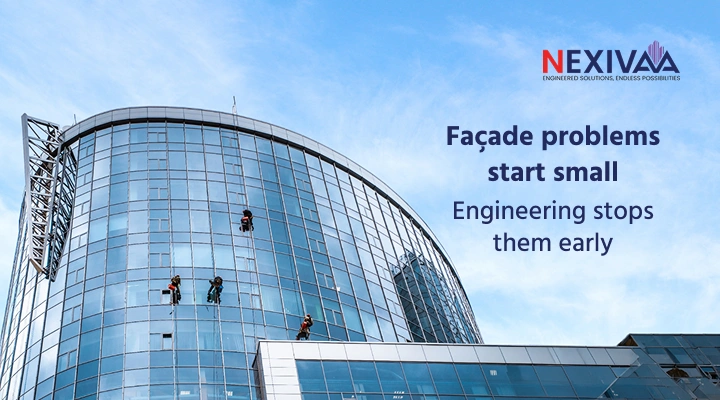
A common oversight in façade design is failing to plan for long-term maintenance. Façades require regular cleaning, inspection, and occasional repairs. Without proper access strategies, routine maintenance becomes unsafe, expensive, or impractical.
Designing façades with maintenance and access in mind improves safety and reduces lifecycle costs.
Mistake 6 – Using incompatible materials and systems
Different façade materials expand, contract, and age at different rates. When incompatible systems are combined without proper analysis, issues such as cracking, corrosion, staining, and uneven aging can occur. These problems often worsen over time and are difficult to fix after installation.
An experienced façade contractor ensures materials work together as a unified system.
Mistake 7 – Skipping performance analysis and testing
Proceeding without wind load analysis, thermal modeling, or moisture assessment is a major cause of façade design issues. Without performance validation, buildings may experience air leakage, condensation, acoustic issues, and structural movement.
Performance studies help identify risks early, when design changes are still practical and cost-effective.
Mistake 8 – Disconnect between design and site execution
Even a well-designed façade can fail if construction realities are ignored. Installation tolerances, workmanship quality, sequencing, and supervision all affect final performance. Designs that do not account for site conditions often result in compromised execution and reduced façade durability.
Aligning design intent with on-site practicality is essential for successful façade delivery.
Why avoiding façade design mistakes matters
Façade design mistakes affect more than just appearance. They influence energy efficiency, occupant comfort, safety, and long-term asset value. Many façade design problems remain hidden for years before emerging as costly repairs.
Addressing façade design issues early helps reduce risk, control costs, and protect long-term building performance.
How Nexivaa helps deliver better façade outcomes
Nexivaa is a specialized façade company delivering precision-led façade and fenestration consulting for complex building projects across India. As a trusted façade design company, we focus on performance, buildability, and long-term reliability.
Our services include:
- End-to-end façade consulting from concept to execution
- Technical detailing and system optimization
- Coordination support for architects, developers, and façade contractors
- Performance-driven design focused on durability and efficiency
Avoiding façade design problems starts with the right expertise at the right stage. We deliver façades that perform reliably, age gracefully, and protect long-term project value. Partner with us to build with confidence from day one. Call now for more information!
FAQs
1. What does a façade consultant do?
A façade consultant manages the design, performance, and coordination of the building envelope to ensure durability and efficiency.
2. When should a façade company be involved in a project?
A façade company should ideally be involved during early design stages to align architectural intent with technical requirements.
3. Do façade design issues appear immediately after construction?
No. Many façade design issues develop gradually and may appear years after completion.
4. How does façade design affect maintenance costs?
Good façade design reduces water ingress, material failure, and access challenges, lowering long-term maintenance expenses.
5. Can façade problems be fixed after construction?
Some issues can be corrected, but resolving them during the design stage is far more cost-effective.