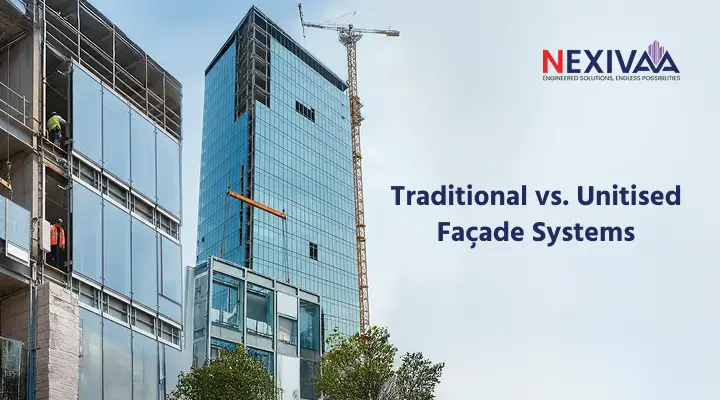
The evolution of façade technology has revolutionized the design, construction, and maintenance of modern buildings. From energy efficiency to installation speed, every element of a façade system influences the overall performance and visual impact of a structure. Two of the most common systems in façade construction today are traditional façades and unitised façade systems.
This blog examines the differences between these two approaches, their advantages and limitations, and how the right façade choice can enhance both design and performance, especially in high-rise and large-scale projects.
Understanding Traditional Façade Systems
A traditional façade system, also known as a stick-built façade, is constructed by assembling components such as mullions, transoms, glass, and cladding panels directly on-site. This method remains popular for low- to mid-rise buildings where customization and flexibility are key.
Key Features and Advantages:
- On-site assembly: Components are fabricated separately and installed on-site, allowing for real-time adjustments during construction.
- Design flexibility: Ideal for front façade design that involves unique architectural elements or irregular layouts.
- Lower initial investment: Generally, it is more cost-effective at the start compared to prefabricated systems.
- Ease of maintenance: Individual parts can be repaired or replaced without affecting the entire façade.
Limitations:
- Longer installation time: Since most work is conducted on-site, project timelines can be extended.
- Variable quality: Performance may fluctuate depending on site conditions, weather, and workmanship.
- Skilled labor dependency: Requires experienced installers to ensure alignment, sealing, and precision.
Despite these challenges, traditional façades remain a preferred choice for smaller or custom-designed projects where craftsmanship and design flexibility are most important.
Understanding Unitised Façade Systems
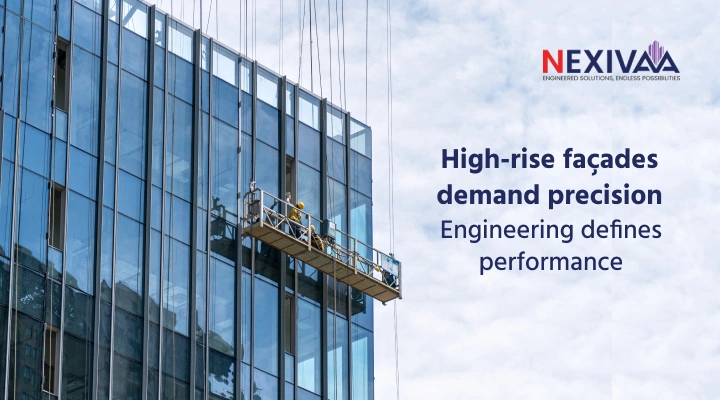
A unitised façade system is a modern, pre-engineered façade solution where panels or modules are manufactured in a factory and then installed directly on-site. It is widely used in high-rise façade design, large offices, and commercial projects where speed, precision, and performance are essential.
Key Features and Advantages:
- Factory fabrication: Most work, including glazing and sealing, is performed in a controlled factory environment, ensuring consistent quality and minimizing on-site risks.
- Fast installation: Prefabricated panels are installed floor by floor, allowing for quicker project completion and parallel interior work.
- Better performance: Offers improved insulation, airtightness, and weather resistance, supporting sustainable and energy-efficient design.
- Enhanced safety: Minimal on-site work reduces exposure to weather and height-related risks.
Limitations:
- Higher upfront cost: Precision manufacturing and transportation add to the initial investment.
- Limited on-site modification: Once panels are fabricated, it is difficult to implement design changes.
Despite the higher cost, unitised façades are the go-to choice for modern, large-scale buildings where long-term durability, quality control, and installation efficiency are priorities.
Comparing Traditional and Unitised Façade Systems
Both systems serve the same fundamental purpose: protecting the building envelope while enhancing its appearance, but their methods differ significantly.
A traditional façade system is typically built component by component on-site, making it slower but highly adaptable. It’s cost-effective initially and works best for low- and mid-rise structures, where design flexibility is more important than installation speed.
In contrast, a unitised façade system is produced off-site and installed as complete units. This allows faster assembly and higher precision, which is especially advantageous for high-rise façade design. Though the upfront cost is higher, it provides long-term savings through better energy performance, reduced maintenance, and minimal site disruption.
When choosing between the two, project type and requirements play a defining role. For small or custom-shaped buildings, a traditional system provides more flexibility and control. For large-scale or repetitive projects, a unitised system delivers superior speed, consistency, and performance.
Applications in Modern Architecture
The choice of façade system depends on the project’s scale, budget, and design objectives.
- Low- and Mid-Rise Projects:
Traditional façades are best suited for smaller buildings such as schools, offices, or residential complexes where individual customization is required. - High-Rise Buildings:
Unitised façades are preferred for tall structures that demand quick installation, minimal on-site labor, and long-term reliability. - Commercial & Institutional Structures:
Airports, hospitals, and corporate buildings benefit from unitised façades because they balance durability, design precision, and environmental performance. - Renovation Projects:
In refurbishments or retrofits, traditional façades are easier to integrate with existing building elements.
Choosing the Right Façade System
Deciding between traditional and unitized façades depends on several key factors: building height, timeline, budget, and desired aesthetics.
Opt for a unitised façade system when your project demands quick installation, high precision, and energy efficiency, especially in high-rise or commercial developments. On the other hand, a traditional façade system is ideal when design variation, on-site flexibility, and lower costs are your main priorities.
Ultimately, both systems play an important role in shaping the architectural identity and energy performance of buildings. The right façade approach harmonizes creativity, engineering, and long-term functionality.
Nexivaa: Redefining Façade Design and Engineering Excellence

As a leading façade company, Nexivaa combines architectural innovation with engineering precision to deliver façades that perform beautifully and efficiently. We specialize in façade design, including front façade design and high-rise façade design, offering comprehensive project support from concept development to execution.
Our expertise covers both traditional and unitised façade systems, enabling us to tailor solutions that suit each client’s architectural vision and performance goals. Every project we handle is guided by precision, quality control, and sustainability; ensuring your building envelope achieves measurable outcomes in energy efficiency, aesthetics, and longevity.
At Nexivaa, façades are more than just outer shells; they are intelligent systems that shape comfort, identity, and performance. Whether you are developing a commercial high-rise or a modern residence, our technical excellence and collaborative approach make us the ideal partner for your façade journey.
Call us today to discuss your façade design goals and discover how Nexivaa can bring your architectural vision to life.
FAQs
1. What façade services does Nexivaa offer?
Nexivaa provides façade and fenestration services, including design, system engineering, inspection, and performance optimization across all project scales.
2. What makes Nexivaa different from other façade companies?
Our approach integrates aesthetics with measurable performance outcomes, ensuring façades that are both visually striking and functionally efficient.
3. Can Nexivaa assist with both traditional and unitised systems?
Yes, Nexivaa offers expertise in both systems and helps clients choose the most suitable approach based on project goals and site conditions.
4. Why is façade design important for building performance?
A well-engineered façade enhances insulation, reduces air infiltration, and improves comfort, ultimately leading to improved energy efficiency and sustainability.
5. Does Nexivaa handle high-rise façade projects?
Absolutely. Nexivaa specializes in high-rise façade design, delivering precision-driven engineering for complex and large-scale projects.