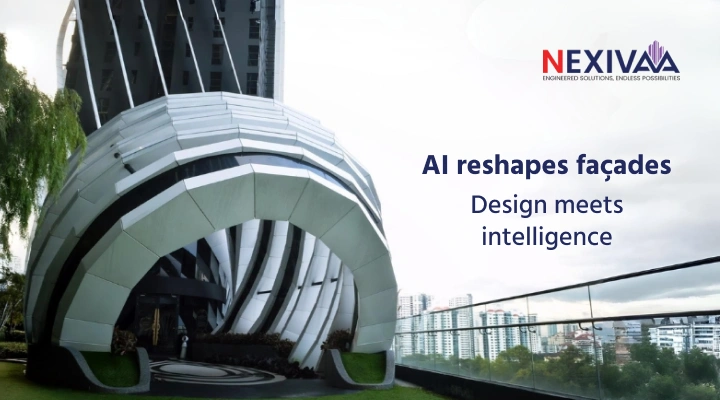
The building envelope industry is undergoing a major transformation in 2026, driven by artificial intelligence and generative design. These technologies are no longer experimental concepts used only in advanced research environments. They are now practical tools that are fundamentally changing how façade solutions are conceived, tested, and delivered in real-world projects.
Instead of relying solely on experience and multiple rounds of manual revisions, design teams are using intelligent systems that evaluate performance data and generate optimized design options automatically. From early-stage concept development to detailed engineering and construction coordination, AI is reshaping façade workflows and accelerating decision-making.
Generative design tools can process environmental inputs such as solar exposure, wind pressure, daylight levels, and thermal behavior at the very beginning of the design process. This allows performance to be embedded into façade solutions from day one, rather than corrected later through costly adjustments. As a result, façades in 2026 are not just designed for appearance; they are engineered for efficiency, resilience, and long-term value.
How generative design replaces manual iteration
Traditionally, façade design required multiple rounds of manual refinement. Adjusting glazing ratios, shading depth, or material combinations often meant recalculating performance metrics and revising drawings repeatedly. This process was time-consuming and dependent on sequential decision-making.
Today, AI-powered platforms can generate and evaluate thousands of design variations within minutes. Designers can instantly compare how different geometries or materials affect energy efficiency, constructability, and cost.
This shift enables architects, engineers, and every forward-thinking façade company to make informed decisions earlier. Rather than relying on assumptions, teams can assess multiple façade solutions simultaneously and select strategies that balance aesthetics, performance, and budget with greater confidence.
AI-driven performance simulation
One of the most significant impacts of AI is in predictive simulation. Instead of designing first and validating later, generative algorithms now integrate environmental data directly into the design workflow.
AI tools analyze:
- Solar exposure patterns
- Wind load behavior
- Thermal performance
- Glare and daylight penetration
- Structural movement tolerances
This transforms façade design into a data-responsive system rather than a static exterior surface. The result is façade solutions that optimize energy efficiency while maintaining architectural intent.
For façade contractors, this predictive modeling reduces design ambiguity and minimizes costly revisions during construction.
Generative geometry and complex forms
Modern architecture increasingly embraces complex forms, curved surfaces, irregular grids, and dynamic envelopes that push beyond traditional rectilinear structures. In the past, designing and executing such geometries required extensive manual modeling, repeated revisions, and significant coordination between architects and engineers. AI-driven generative design changes this process entirely.
Using parametric logic, designers can define performance goals and geometric rules rather than manually drafting every element. The system then generates multiple design variations based on structural constraints, environmental factors, and material behavior.
Through this approach, digital tools can:
- Automatically adjust panel configurations to match curvature and structural loads
- Optimize shading angles based on solar orientation and seasonal analysis
- Adapt structural grid alignment to improve constructability
- Calculate material quantities and fabrication data in real time
For large commercial towers and retail developments, these workflows improve dimensional accuracy, minimize waste, and enhance coordination between designers and facade contractors. The result is greater fabrication precision, smoother installation, and fewer on-site corrections.
Cost optimization through intelligent design
AI not only enhances creativity but also strengthens cost control. By analyzing material performance, constructability, and lifecycle durability simultaneously, AI tools identify the most efficient design strategies.
A façade company leveraging AI can:
- Compare material lifespan performance
- Assess installation sequencing
- Identify structural redundancies
- Forecast maintenance cycles
This integrated approach ensures façade solutions are financially viable, not just visually compelling.
Digital coordination between stakeholders
One of the biggest challenges in façade delivery has always been coordination. Generative design tools now bridge gaps between architects, structural engineers, façade contractors, and procurement teams.
Shared digital models allow:
- Real-time updates
- Clash detection before site work begins
- Automated bill of quantities
- Enhanced transparency across project phases
For façade contractors, this reduces site-level conflicts and accelerates decision-making.
AI and sustainability in 2026
Sustainability targets are becoming stricter. AI enhances compliance by embedding energy modeling, embodied carbon tracking, and daylight analysis directly into façade design platforms.
Generative algorithms can suggest façade solutions that reduce cooling loads, enhance natural ventilation, and minimize operational energy demand. This proactive approach ensures that environmental responsibility is embedded in the design logic rather than added as a corrective layer.
Risk mitigation and quality assurance
AI-driven façade workflows improve predictability. Structural stress testing, movement tolerance simulation, and environmental stress modeling can be conducted digitally before fabrication begins.
For façade contractors and developers, this means:
- Reduced technical risk
- Improved quality control
- Fewer post-installation performance failures
- Higher client confidence
In 2026, AI is not replacing engineering expertise. Instead, it is augmenting human decision-making with data-backed precision.
Why Nexivaa leads AI-driven façade solutions in India
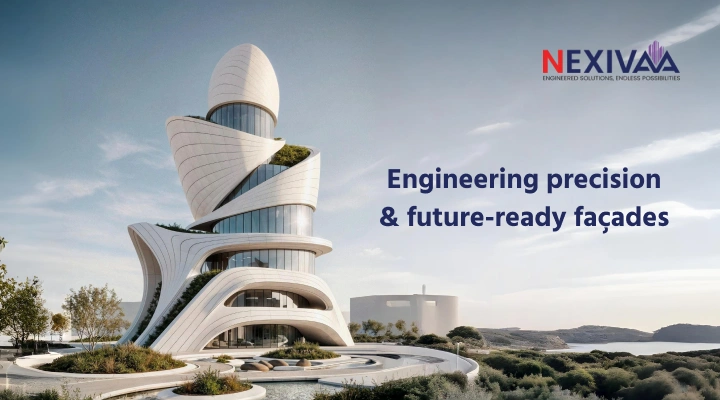
As AI and generative design reshape façade solutions in 2026, Nexivaa delivers performance-focused consultation backed by digital intelligence and engineering precision. As an independent façade company, we support commercial projects through:
- Concept-stage façade design strategy
- Generative modeling and performance validation
- Constructability reviews and technical detailing
- Coordination with façade contractors
- Fenestration system evaluation and optimization
Every façade design solution is developed to ensure durability, efficiency, and long-term value.
Is your project ready for intelligent façade innovation? Partner with us today and elevate your façade solutions with future-ready expertise.
FAQs
1. What makes Nexivaa different from a typical façade contractor?
Nexivaa functions as an independent façade consultant rather than a conventional façade contractor. While façade contractors focus on fabrication and installation, Nexivaa emphasizes performance validation, risk mitigation, and technical oversight. This ensures design intent aligns with structural, environmental, and lifecycle considerations before execution begins.
2. Does Nexivaa offer AI-integrated façade design services?
Yes. Nexivaa integrates digital analysis and advanced modeling techniques into façade design workflows. This allows predictive performance simulation, system optimization, and constructability validation, ensuring smarter and more resilient façade solutions.
3. Can Nexivaa support fenestration consultation projects across India?
Absolutely. Nexivaa provides façade and fenestration consultation services for commercial, high-rise, and mixed-use developments across India. Our expertise covers glazing systems, framing integration, and performance-driven detailing.
4. At what stage should Nexivaa be involved in a project?
Early involvement is recommended. Engaging Nexivaa during concept or pre-tender stages allows performance integration, cost optimization, and risk identification before construction begins.
5. How does Nexivaa ensure long-term façade performance?
Through detailed system evaluation, material compatibility analysis, structural validation, and compliance review, Nexivaa ensures façade solutions deliver durability, energy efficiency, and regulatory adherence over the building lifecycle.