
Most people see a building’s exterior as just design, a visual statement.
We see it as a performance metric.
This performance focus defines our approach at Nexivaa, based in Greater Noida and working across Delhi NCR and India, where we operate as a façade engineering consultant, concentrating on how a building responds to wind, water, heat, and time, not just how it looks.
In the discussion below, Raj Singh, Co-founder and Principal Consultant at Nexivaa, highlights these key takeaways: our structured, performance-focused approach, major industry gaps, and the need for Indian façade consulting to be driven by measurable results.
The cost of unstructured façade knowledge in India
Façade engineering in India evolved without formal learning. Most join from mechanical, civil, or architectural backgrounds. This brings diversity and inconsistency.
What we see on projects is not a lack of intent. It is a lack of alignment.
Specifications are often reused across projects without adapting to site conditions. A high-rise building in Mumbai, with heavy rainfall and wind exposure, requires a very different façade strategy than a mid-rise structure in Delhi NCR. Yet in many cases, similar specifications are applied.
This creates two types of problems, which are essential to recognize:
- Over-specification, which increases cost without adding real value
- Under-specification, which leads to performance failures over time
As façade engineering consultants, our key takeaway is the need to bridge the gap between what is specified and what is actually required, ensuring alignment for every project.
Why we started with training and not consulting
When we started Nexivaa in 2020, we did not position ourselves as a consulting firm.
We started with training.
Across India, we worked with contractors, engineers, and façade teams executing projects but lacking access to structured knowledge. The same questions kept coming up. How do we calculate wind load? What defines water tightness? How do we choose the right system?
This is where we realized something important.
A key lesson: Awareness without application does not solve problems. Applying knowledge is crucial for project success.
This moved us from theory to execution, expanding into façade engineering services, supporting companies with engineering calculations, shop drawings, and system-level decisions before evolving into complete consultant services for developers and architects.
Over time, this evolved into complete façade consultant services, where we work directly with developers and architects to define performance from the start.
Specifications that match site reality
One of the most critical shifts in our work came when we started reviewing project specifications in detail.
We found that many specifications were not aligned with:
- Local climate conditions
- Building height and exposure
- Functional requirements of the space
- Budget constraints
For example, water-tightness requirements in Mumbai are significantly higher due to rainfall and wind conditions. Applying the same requirement to a project in a low-rainfall region results in unnecessary cost escalation.
As façade design consultants, a key takeaway is to approach each project in context, not by default.
We assess orientation, environmental exposure, building use, and performance needs before defining specifications, ensuring each system is engineered for its true environment, not copied from another project.
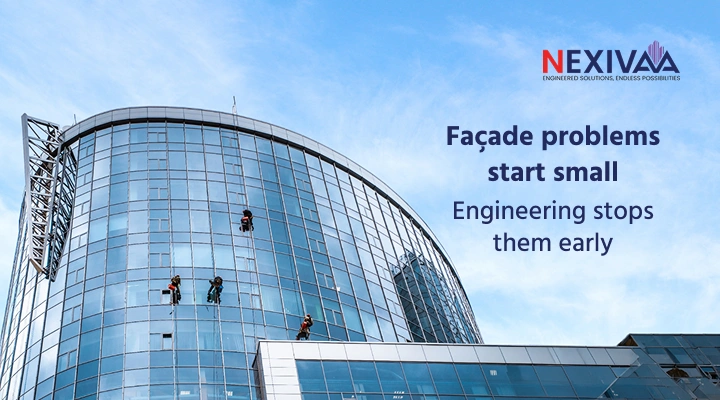
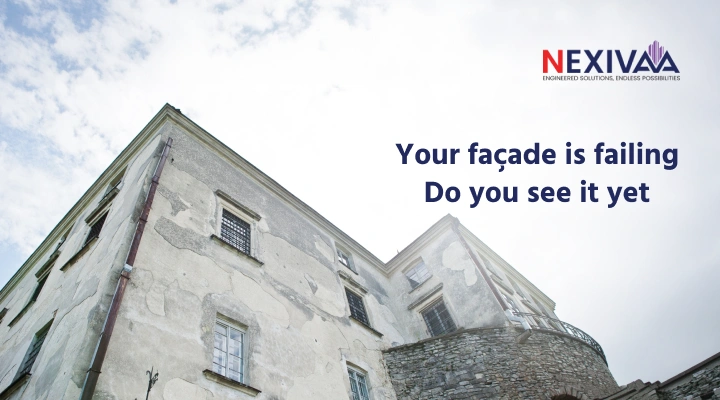
Where most façade failures actually happen
There is a common assumption that façade issues are design problems.
In our experience, most failures happen during execution.
We’ve seen well-designed systems fail due to small, critical gaps during execution.
Survey errors that impact installation
If the initial site survey is even slightly inaccurate, it affects alignment, joint performance, and installation quality. These errors compound as the project progresses.
Fabrication and joint treatment issues
Improper sealing, poor joint treatment, and inconsistent fabrication practices directly impact water tightness and durability.
Installation without performance awareness
Many site technicians lack knowledge of wind loads, fixing depths, or performance. This gap between design and execution causes long-term issues.
For any façade company or contractor, a key insight is that workmanship fundamentally defines whether the system performs.
Value engineering is not cost-cutting
In many projects, value engineering is misunderstood as reducing cost.
For us, it is about optimizing performance.
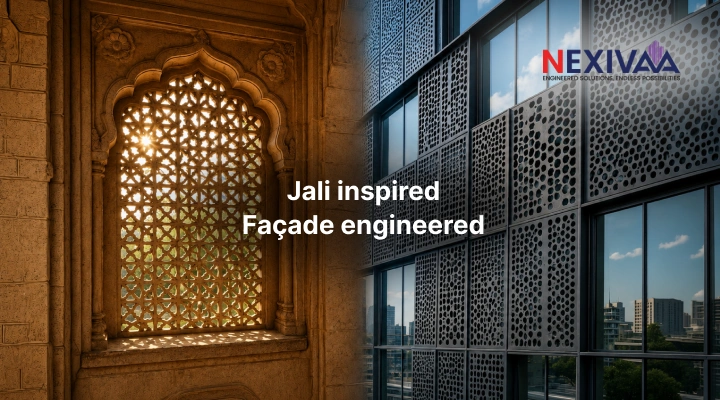
Rather than blindly increasing specifications, we evaluate where performance can be achieved efficiently, such as by optimizing system configurations or introducing shading elements, like chajjas, to reduce water exposure and costs.
For example, shading elements like chajjas reduce water exposure, allowing optimized water-tightness without hurting performance.
System configuration changes can improve air tightness and thermal performance with minimal added cost.
The goal is always the same.
The key takeaway: deliver performance fit for the project, never excessive or insufficient.
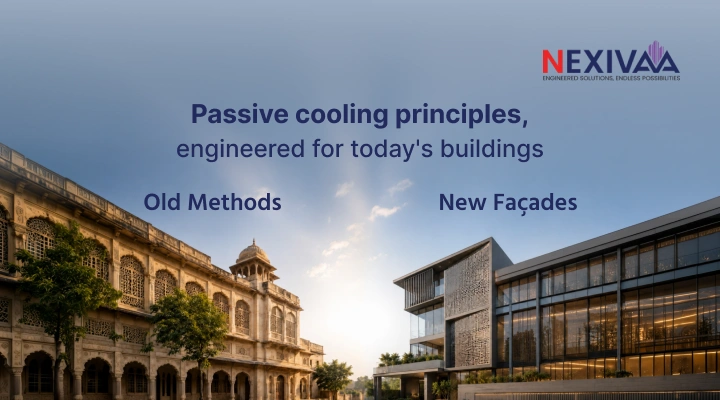
How façade design impacts energy performance
Façades significantly affect a building’s energy use, especially in Delhi NCR’s extreme climate.
Glass selection is one of the most critical decisions in this process. Choosing the wrong glass can significantly increase cooling loads. We evaluate parameters such as U-value, solar heat gain, and daylight requirements based on building orientation and use.
Air tightness is equally important. Even with the right materials, poor sealing can lead to energy loss.
The main takeaway: A performance-driven façade approach can greatly reduce energy use and improve building operation.
Building expertise and making it visible
In a niche domain like façade engineering, expertise is the foundation of the business.
But expertise alone is not enough.
When we started, most of our work came through referrals. While this built a strong base, it limited our reach. Developers and architects in other regions had no way of knowing what we were doing.
A key lesson: Building visibility via digital platforms enabled us to reach a wider audience with our expertise.
It allowed us to:
- Communicate what we do and how we do it.
- Reach developers and consultants beyond our immediate network.
- This shift allowed us to communicate our work, reach new audiences, and generate inquiries from other geographies, including internationally, helping scale our business beyond local projects.
This shift is critical: Expanding our reach online was a key factor in scaling as a façade engineering consultant beyond local projects.
Conclusion
The key gap in India’s façade industry is not capability, but a lack of structure in knowledge and practice. The main takeaway: bridging design, engineering, and execution is vital.
Our role as a façade engineering consultant is to bring that structure in.
By aligning specifications with site conditions, matching execution to design, and focusing on long-term performance, our key takeaway is: deliver façades that both look and perform superbly.
Planning a façade project? Let’s start with clarity

If you are working on a project in Delhi NCR or anywhere in India and want to ensure your façade system is aligned with performance, cost, and execution from the start, we can help.
We work with developers, architects, and contractors to identify gaps early and define systems that work in real conditions, key steps for successful façades.
Reach out to us to start the conversation.